My Story
I created AquaCoda to explore what aquatic animals may be communicating beneath the surface, together with a community of citizen scientists.
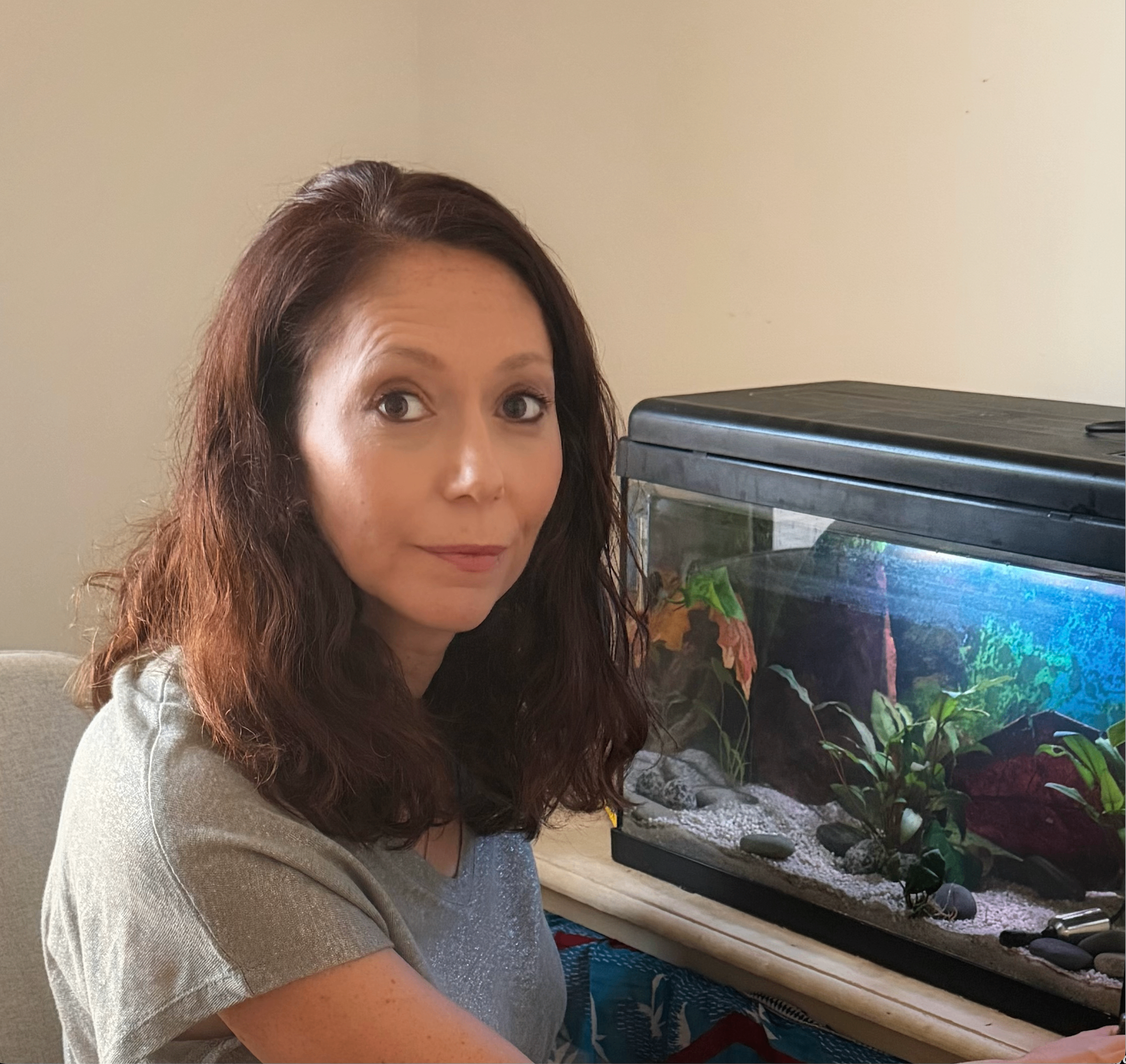
I am Sophie Cohen-Bodénès, a neuroscientist and animal-behaviour researcher with a PhD in Neuroscience. Throughout my research, I have been fascinated by the ways animals perceive their world and communicate. After my PhD I conducted a 2-year post-doc research project at Washington University School of Medicine in Saint Louis working on the Sensory Neuroscience of Zebrafish and communication in Danionella fish.
I have always been fascinated by how animals communicate
I have a PhD in Neuroscience, and my work has focused on perception, animal behaviour and communication. I have always been interested in the signals animals use to interact with one another—especially the signals that humans may overlook because they are expressed through movement, colour, vibration or sound rather than words.
My scientific journey has taken me across neuroscience, sensory biology and animal behaviour. It has taught me that understanding another species begins with careful observation, patience and the willingness to question our assumptions.
My research on cuttlefish changed the way I think about communication
During my research, I became deeply interested in cuttlefish communication. Cuttlefish are remarkable animals that communicate through rapidly changing body patterns, colours, postures and movements.
During my research, I had the priviledge to spend time observing and interacting with cuttlefish. I ended up documenting an hypothetical communication signal in the cuttlefish : the arm wave signs.
Studying cuttlefish taught me that communication can exist in forms that are very different from human language. A movement that appears simple to us may carry information when it is produced repeatedly, directed toward another animal and interpreted within a specific social context.
Cuttlefish arm-wave display
A short glimpse into the arm-wave displays I studied during my cuttlefish research.
The precise function and meaning of these displays remain under investigation.
From cuttlefish communication to AquaCoda
My research on cuttlefish made me wonder how many meaningful signals remain undocumented in other aquatic species.
Scientists can study only a limited number of animals and situations. Meanwhile, people who live with fish, aquatic frogs, shrimp and other aquatic animals observe them every day. I believe that they can contribute to scientific discovery as well.
They notice individual routines, unusual movements, interactions, sounds and changes over time. Many of these observations are never recorded or compared.
I created AquaCoda to help transform these everyday moments into structured observations that can be explored collectively.
BettaCoda was the first step
I first began developing this idea through BettaCoda, a project focused on the behaviour and possible acoustic communication of Betta splendens.
Betta fish are often perceived as simple ornamental animals but close observation reveals individual personalities, complex displays, territorial behaviour and captivating courtship parades.
I once heard my Betta making an unsual sound and introduced an hydrophone to record further sound events. It appeared that Betta, currently assumed to be silent, may communicate with sounds as well.
I wanted to create a way to document these behaviours carefully, compare them across individuals and invite fish keepers to take part in the scientific process.
BettaCoda became the first focused project within the broader AquaCoda platform.
Why I created AquaCoda
I created AquaCoda because I believe aquatic-animal owners can make meaningful scientific contributions. The required quality are patience, curiosity, and passion.
A person who observes the same animal every day may notice patterns that are difficult to capture during a short laboratory experiment.
AquaCoda provides a place to record those moments, add context, share media, compare observations and contribute to a growing behavioural dataset.
My goal is to bring together citizen scientists, aquarists, researchers and aquatic-animal professionals around a shared question:
What can careful observation teach us about the lives and signals of aquatic animals?
For me, AquaCoda is both a scientific project and a personal mission. I want aquatic animals to be seen as individuals with their own behaviours, preferences and ways of interacting with the world. I also want science to become more open and participatory. People should not need to work in a laboratory to ask meaningful questions, document behaviour or contribute to collective knowledge.
Why I believe in citizen science
No researcher can observe every animal, species, aquarium or naturally occurring event.
Citizen scientists can help expand what is observable by documenting behaviours across many animals, environments and moments in time.
When observations are recorded carefully and ethically, they may help reveal recurring patterns, individual differences and new research questions.
Everyday behaviours matter. An observation does not need to be dramatic or unusual to be valuable.
Animal welfare comes first
I created AquaCoda to encourage careful observation, not to encourage people to provoke behaviours for a recording.
No contribution is worth causing stress.
Animals should never be chased, handled unnecessarily or deliberately exposed to aggression, mirrors, distress or repeated social conflict simply to obtain a video.
I also noticed that the use of betta flaring stick or mirror is widespread and evoke stressful displays like excessive flaring. I want to raise awareness about welfare and enrichment practices with BettaCoda.
The most valuable observations are often quiet, naturally occurring moments that show how an animal behaves in its normal environment.
Observe naturally. Never provoke a behaviour for a contribution.
How I see the role of AI
I believe AI may eventually help organise large behavioural datasets, detect recurring patterns and identify observations that deserve closer investigation.
But AI should support scientific reasoning, not replace it.
AquaCoda will not claim that a movement, sound or display has been decoded unless the evidence genuinely supports that conclusion.
A team of scientific expert will review carefully each label before training the AI.
I also wish to promote transparency and ethics in training AI datasets. With AquaCoda, each contributor gives its consent (or not) to share his data for future AI training.
Future tutorials will give the opportunity to open the AI black box. I will launch AquaCoda Academy soon and share knowledge on how AI works to decipher animal communication, Fish Neuroscience and Cognition.
I want to build this project with a Community
AquaCoda is not meant to be built by one person alone.
I want it to become a place where aquatic-animal enthusiasts, citizen scientists, researchers and professionals can share observations, suggest labels, learn from one another and develop new questions together.
Every contribution helps the platform grow, not only through data, but through the experience, curiosity and care of the person who shares it.
Where I hope AquaCoda will lead
My long-term goal is to build a diverse and responsibly collected dataset of aquatic-animal behaviour and possible communication signals.
I hope this work can support comparative behavioural research, animal-welfare knowledge, educational resources and future AI-assisted analytical tools.
Above all, I hope AquaCoda encourages people to look at aquatic animals differently, not as silent decorations, but as living individuals whose behaviour deserves attention.
Discover more about my academic work
I am a neuroscientist and animal-behaviour researcher with a PhD in Neuroscience. You can visit my academic website to learn more about my research, publications, scientific background and work on animal perception and communication.
Join me beneath the surface
AquaCoda is still at the beginning of its story.
You do not need to be a professional scientist, and you do not need to witness an extraordinary behaviour.
By sharing what you naturally observe, you can build a behavioural record of your own aquatic animal and contribute to a wider scientific adventure.
Become a citizen scientist and help me explore the signals beneath the surface.
Sophie Cohen-Bodénès, PhD
Founder of AquaCoda and BettaCoda
Neuroscientist and animal-behaviour researcher