BettaCoda
AquaCoda's flagship project.
Documenting Betta fish behaviour and investigating possible sound communication through responsible citizen science.
A collective research journey to discover if Betta Splendens communicate with sounds.
What is BettaCoda?
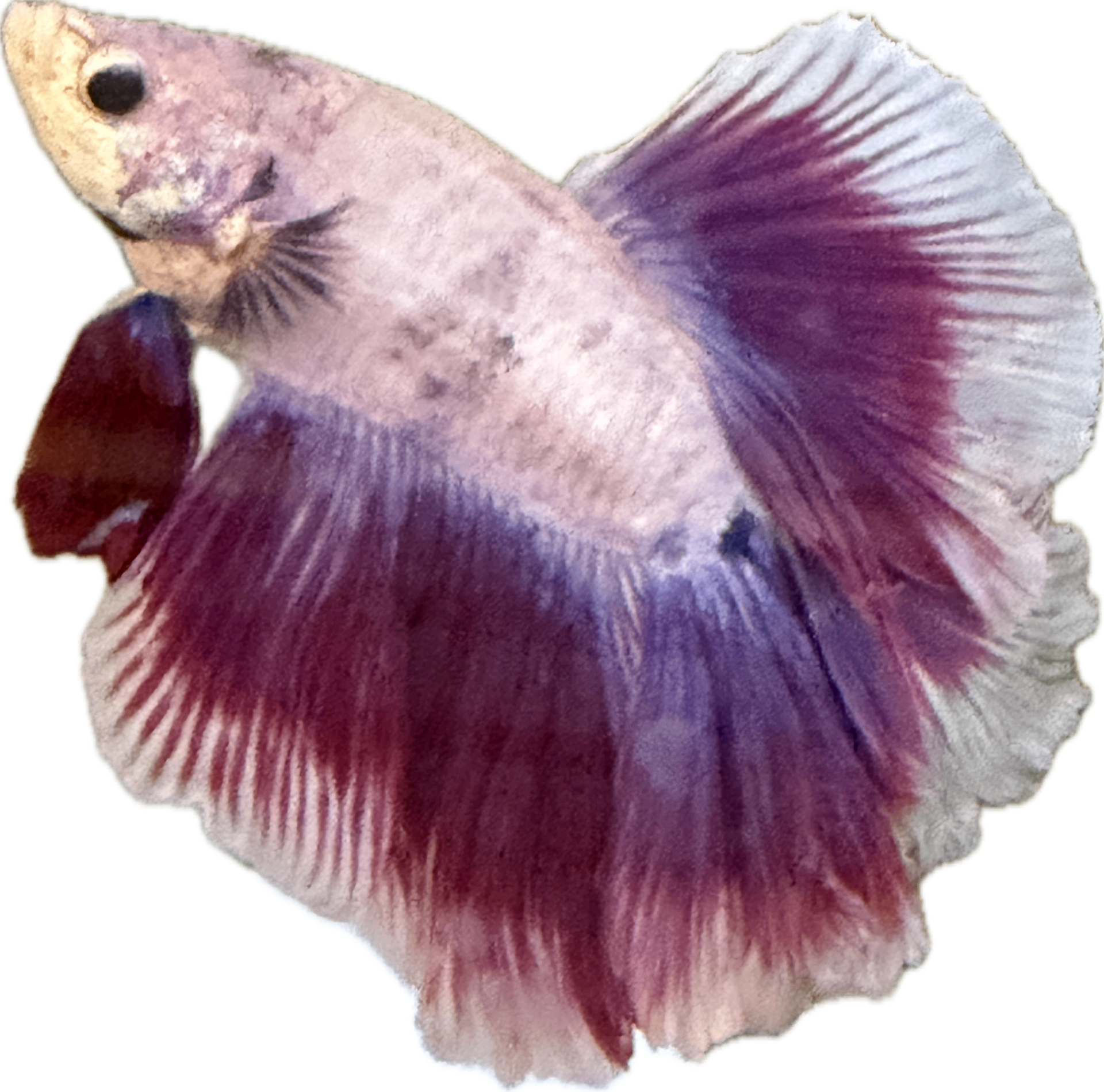
BettaCoda is a citizen-science project dedicated to documenting the behaviour and communication of Betta splendens.
Currently, Betta fish are not known to communicate with sounds. Based on preliminary observations of Betta fish emitting sound during behavioral context, BettaCoda invites the community of citizen scientists to decipher the meaning of those sounds.
Can Betta fish communicate with sound?
Preliminary observations suggest that some Betta fish may produce sounds in specific behavioural contexts.
BettaCoda collects passive video and sound recordings so these events can be compared and investigated.
Listen to a Betta sound recording
This short audio extract was recorded during the observation of a Betta fish. It is shared as a preliminary example of a possible fish-produced sound for further documentation and comparison.
Pulse train, clicks, low-frequency "sonic" and "metallic" sounds are evocative of fish sound signals.
How to record possible Betta sounds responsibly
- Record passively during a quiet moment, without interacting with the fish or the tank.
- Use a phone, field recorder, or a hydrophone introduced gently in the tank. Never tap the glass or move equipment abruptly.
- Keep pumps, filters and lights in their usual state so the recording reflects normal husbandry conditions.
- Note the behavioural context and time, and stop recording if the fish shows any sign of stress.
What this recording is, and isn't
- Aquarium recordings can contain many possible sources: pumps, filters, bubbles, substrate movement, tank resonance, or ambient room noise.
- Do not provoke, chase, or expose the fish to mirrors or other fish to trigger a reaction.
- A single extract is a starting point for careful comparison, not proof of vocal communication or intentional meaning.
Fish sound signals are low and subtle. They require patience to hear. Do not feel discouraged it you do not hear sound immediately. Fish kept solitary will emit sounds more sporadically.
Bubble nesting
A Betta fish creating bubbles at the water surface as part of bubble-nest-building behaviour.
How to contribute
Step 1
Observe
Document spontaneous behaviour under normal husbandry conditions.
Step 2
Record
Capture a photo, video or sound recording without disturbing the fish.
Step 3
Share
Choose whether the observation remains private, appears in Community or contributes to Research.
Why your observations matter
Individual observations can be difficult to interpret. By combining observations from many Betta fish, BettaCoda may help identify recurring behavioural and acoustic patterns.
These structured datasets may support scientific research and future AI-assisted analysis.
Every careful observation adds to the dataset.
From citizen science to future AI research
AquaCoda's long-term ambition is to develop AI-assisted tools that may help identify and compare patterns in aquatic-animal behaviour and communication.
These tools are still a research objective and must be interpreted with scientific care.
Learn about Research and AIWelfare comes first
Record only spontaneous behaviour under normal husbandry conditions.
- Do not use mirrors to provoke flaring
- Do not force encounters between fish
- Do not disturb essential aquarium conditions
- Stop recording if the fish shows signs of stress
Listening to the Siamese Fighting Fish
Read the preliminary BettaCoda observations and the passive recording approach used to document possible sound production.
A shared project
BettaCoda brings together fish keepers, citizen scientists and researchers interested in Betta behaviour and communication.
Help document Betta behaviour and communication
Observe responsibly, share what you discover and contribute to the BettaCoda citizen-science project.