Observe. Share. Discover 

AquaCoda

What if your fish could talk? 

AquaCoda is a citizen-science platform where aquatic-animal owners and observers can document behaviour, visual displays and sounds. Whether you keep a Betta fish, or another aquatic species, your observations help build a shared database for studying how aquatic animals communicate.

Become a citizen scientist and discover the meaning of the signals beneath the surface.

FlagshipBettaCoda - Deciphering the meaning of sound communication signals in the Betta fish

Already have an account? Log in

AquaCoda emblem: a water drop containing a betta fish and sound waves
Explore

AquaCoda is currently in Beta

You are using an early version of the platform. Some features are still being improved, and your feedback helps us make AquaCoda clearer, easier and more useful.

See AquaCoda in action

Discover how to share your first observation

Watch the Demo to see how you can create your account and upload your first observations. Have a a Betta fish? Choose BettaCoda. Any other Aquatic animals, directly join the bigger dataset AquaCoda.

Animal Welfare comes first. Read and agree to the Guidelines before sharing your observations.

With AquaCoda, you can:

Contribute to citizen science

Share observations of aquatic-animal behaviour, sounds and communication. Participate in the discovery of what fish communication signals mean.

Help build research datasets

Your contributions support scientific research and future AI-assisted analysis to decode fish communication signals. 

Learn about fish and improve Welfare

Discover fish behaviour and communication. Improve care, welfare and enrichement.

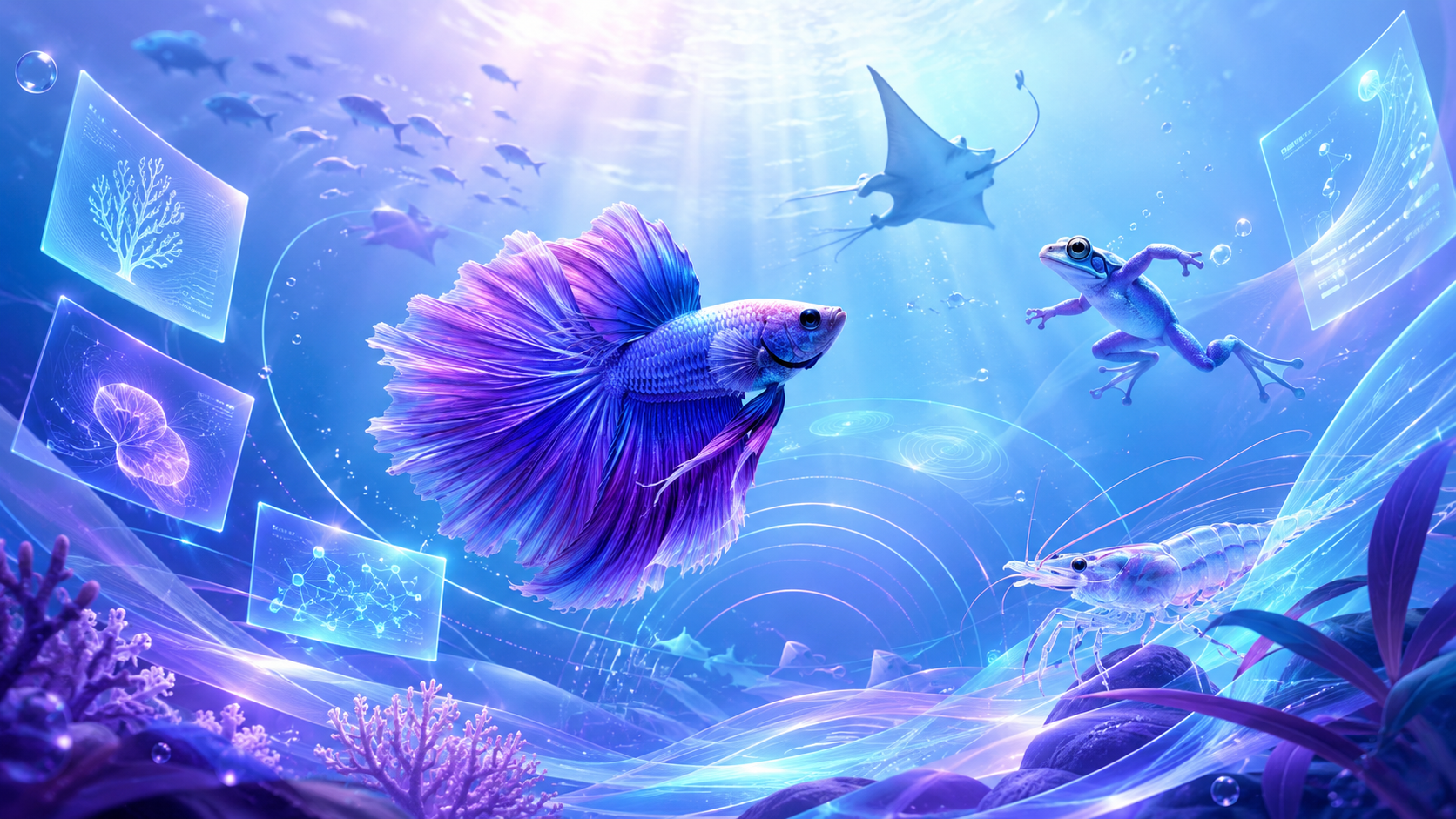
A luminous underwater scene featuring a Betta fish surrounded by other aquatic animals and futuristic scientific overlays, illustrating AquaCoda's observation and research mission.
.

BettaCoda

What if your Betta fish could talk with sounds ?

BettaCoda, AquaCoda flagship project, documents Betta fish behaviour and investigates possible sound communication in the Siamese Fighting fish for the first time. BettaCoda Citizen Scientists participate in the discovery of what those sounds could mean for communication. 

Heard your Betta fish make a sound?

Share videos and sound recordings to help document possible acoustic signals in Betta splendens.

Record only spontaneous behaviour. Never provoke the fish.

ONE PLATFORM, MANY SPECIES

One platform, many aquatic species

BettaCoda is AquaCoda’s first flagship project, focused on Betta fish behaviour and possible sound communication. AquaCoda extends the same citizen-science approach to other fish and aquatic animals.

Multi-species dataset

AquaCoda

For fish and other aquatic animals of many species.

Document behaviour, sounds and communication signals to help create a comparative, multi-species dataset.

Choose AquaCoda for observations of aquatic animals other than Betta fish.

Scope
Multiple aquatic species
Dataset
AquaCoda
Betta splendens dataset

BettaCoda

A dedicated project for Betta splendens.

Document Betta behaviour, visual displays and possible sound production.

Choose BettaCoda when the animal observed is a Betta fish.

Scope
Betta fish
Dataset
BettaCoda
Free for all.  No payment required
Example observation

See how a fish behaviour can be documented and shared.

Flaring and surface breathing in a Betta fish

A Betta fish was observed flaring and then rising to the surface to breathe. The behaviour was recorded passively in the home aquarium without deliberately provoking the fish.

  • Flaring
  • Surface breathing

Welfare first

Flaring must never be deliberately prolonged or provoked. Surface breathing can be part of normal Betta respiration, but frequent or unusual surface breathing should be considered alongside water quality and other signs of stress.

Read the Animal Welfare Guidelines

Launch programme

Become a Founding Citizen Scientist

Join the first 100 AquaCoda contributors. Share your first ethical aquatic-animal observation and receive a permanent Founding Citizen Scientist badge.

founding places claimed100 remaining

You do not need a Betta fish to contribute

AquaCoda welcomes observations of many fish and aquatic-animal species.

  • Guppies
  • Goldfish
  • Cichlids
  • Gouramis
  • Catfish
  • Shrimp
  • Aquatic frogs
  • Other responsibly observed aquatic animals

Record spontaneous behaviour, social interactions, visual displays, movements or sounds under normal welfare-friendly conditions.

CITIZEN-SCIENCE DATASET

Building a shared communication database

Each observation adds information about what an animal did, the context in which it happened and the signals that accompanied it.

Bringing together observations from many species may help researchers compare visual, acoustic and behavioural signals and identify patterns that occur across different aquatic animals.

Different species. Shared questions. One growing citizen-science dataset.

Looking for patterns across species

AquaCoda is designed not only to document individual species, but also to explore whether different aquatic animals use comparable signals in similar contexts.

Visual signals

Postures, colour changes, fin displays and movements.

Acoustic signals

Clicks, pulses, knocks and other recorded sounds.

Social and behavioural context

Courtship, aggression, feeding, grouping, exploration and care.

Similar-looking or similar-sounding signals do not automatically have the same meaning; they must be compared carefully and interpreted in context.

LONG-TERM RESEARCH GOAL

From community observations to future AI-assisted research

Structured observations may support future tools that help identify, organise and compare recurring communication and behaviour patterns.

Animal welfare comes first

Animal welfare

Record only spontaneous behaviour under normal husbandry conditions. Do not provoke, train, or induce flaring.

Read the Animal Welfare Guidelines

Become a citizen scientist and discover the meaning of the signals beneath the surface.

Observe responsibly, document what you see and help build a shared citizen-science resource for aquatic-animal behaviour and communication.